Saturday, June 18, 2011


Friday, June 17, 2011
Recently read: "All You Need is Kill" by Hiroshi Sakurazaka

Another Haikasoru book, and one that I liked a lot (not quite as much as Usurper of the Sun or The Next Continent). James Nicoll has been reviewing the Haikasoru books, and gives a good run down of this one here.
We have Keiji Kiriya, a Japanese solider fighting against the "Mimics", aliens which are invading Earth (they appear to be part of a "terraforming" process for the eventual intelligent aliens). Even with power armor (called Jackets here) humans are having trouble holding their own.
Keiji dies in his first combat experience...and then wakes up the day before the battle. He learns that he is in some sort of time loop, returning after each combat death to the same moment the day before. He can alter events within the loop, but always returns upon his death.
In each iteration, he notices Rita Vrataski (the "Full Metal Bitch") who is a legendary American solider. He then finds out that Rita is aware of the loops, and knows how to break the cycle.
This is a short book, so there's not a lot of depth in the other characters, though the author does give you background on Rita. Keiji is falling in love with Rita (and she with him) but there will be a price to be paid for causing the loop to end.
This is a fast moving, well written book, and I hope it gets some traction here in the US. I will say that based upon the cover art, it's not a book that I would have normally picked up, though it does help that it has a cover blurb from John Scalzi.
Recently read: "The Dogs of Rome" by Conor Fitzgerald

The first novel by Fitzgerald, and the first of what is meant to be a series about police chief commissioner Alec Blume, an American expatriate living in Rome.
Blume, a teenager when his art historians parents were murdered during a bank robbery, has grown up to be a loner, but also a sharp police officer. When an animal rights activist, who's wife is also a prominent politician, is killed, Blume must deal with interference from his superiors as he zeros in on his suspect. The victim had ties to the mob (his mistress being the daughter of the local mob chief) and was instrumental in in exposing a dog fighting ring.
I enjoyed the book, though it was hard to get a handle on Blume. He's written as such an outsider, there seems to be no "hook" into his character. I also had to try and understand the Roman police bureaucracy, which was unfamiliar to me, and the sense that casual corruption is an excepted thing (perhaps not that different from modern American police mysteries).
Thursday, June 16, 2011
Recently read: "Hogdoggin'" by Anthony Neil Smith

The second "Billy Lafitte" novel, after Yellow Medicine (which I reviewed here) and the third book by Smith that I've read (the last was Choke on Your Lies, reviewed here).
Our "hero" Lafitte, after the collapse of his career as a deputy in Yellow Medicine (Minnesota), is the right hand man/enforcer of "Steel God", the giant leader of a motorcycle gang in North Dakota, who's leadership is starting to be questioned as his health declines. FBI Agent Rome, banished to New Orleans for his hot dog actions going after Lafitte, has hatched a plan to lure Lafitte back to the Gulf Coast by focusing on his ex wife.
Lafitte tells Steel God that he has to go, and heads south on his turquoise-blue chopper. Bad things happen along the way, and Rome, with his fellow agents, are coming to meet him.
If possible, this book is even darker than Yellow Medicine. Smith takes his characters deeper into violence, with nearly everyone making bad decisions.
Recently read: "In the Shadow of Ares" by Thomas James & Carl Carlsson

This is a self published Kindle book (one of the authors, James, is a Lockheed Martin engineer). After a prolog in 2029, showing the disappearance of the Ares III mission, the book is set on 2051, as colonization of Mars has started. Amber Jacobsen is 14, and a minor celebrity as "the first kid on Mars". She would just like to be able to live on Earth and be a normal teenager.
After her family's homestead is destroyed by an accident, her mother finds a job at the independent settlement near Noctis Labyrinthus. Anxious to show her worth, Amber tries to be of use, but most of the colonists see her as a distraction, even a burden. As a way to prove her use to the colony (and Mars) she vows to find out what happened to the Ares III mission.
There's a lot of politics here, as the colonists are continually at odds with the Mars Development Authority (MDA) (the book is written with a heavy dose of free market economics) and Amber's investigations give the MDA a reason to try and take over the colony.
There's a mystery, with hints of some sort of conspiracy, and danger to Amber (in an almost "Nancy Drew" sort of way) which I found reasonably enjoyable. I did feel that some of the villains weren't well drawn (that is, their motives seem to come out of left field) and the MDA is almost a strawman opponent for the authors economic arguments (and that with me agreeing with the core of their libertarianism). The science is pretty good overall, and they've given some thought to how the settlements would be set up.
Overall, a retty good read, though I did have some problems with the formatting on my Kindle.
Monday, June 6, 2011
Megan McArdle talking Art in Politics (and Politics in Art)
“Talent is not wisdom. It's not even connected to wisdom. Art at its best gives us new ways of looking at the world, and this is itself beyond price. But that doesn't mean that art is Good With a Capital G, much less that artists are. They are all unreliable narrators.”
Tuesday, May 31, 2011
Recently viewed: "Battleground"

I'm not that familiar with a lot of the movies that Hollywood made about WWII, and I had never heard of this one until recently, when I happened to find a cheap copy. Made in 1949, it was the first major film about the war that was released after it was over (and the studio was apparently worried that the audience would be tired of war stories). Set during the Battle of the Bulge, it is focused on Seige of Bastogne, as the Germans were trying to get control of the crossroads at Bastogne as a crucial part of their drive to get access to the harbor at Antwerp.
The movie follows the 2nd Squad, 3rd Platoon of Item Company (a ficitonal company) of 327th Glider Infantry Regiment, 101st Airborne Division. To me, it's notably in that the members of the squad appears very human; they are clearly scared at times, and frustrated with the lack of supplies and support that they have. As to the siege, the movie is apparently fairly accurate. There's also a wealth of good performances here, starting with Van Johson as Holley and James Whitmore as Kinnie, the sergeant who continues doing his duty as he deals with frostbitten feet. Notable faces include Ricardo Montalban (Kahn himself!), James Arness and Richard Jaeckel.
The result is a great movie, about an important piece of history. It was a huge hit for MGM, and well regarded (a handful of Oscar nominations, with wins for Best Cinematography, Black-and-White (Paul C. Vogel) and for Best Writing, Story and Screenplay (Robert Pirosh).
Highly recommended.
Recently read: "King Kong"

Yes, this is a "recently read" post, not a "recently viewed" post. I picked up this printing of the Kong novelization a couple of years ago (inspired somewhat by the many "monkey" panels at various ArmadilloCons, along with some comments from Mark Finn about the book).
I was a bit surprised to see that a novelization existed, since I would have thought that the "art" form we think of as novelizations was a relatively recent phenomenon, but I found that they have been written since the 1920's at least.
There's really nothing unexpected here, since it tracks the movie very closely, but there are some interesting changes including:
There is no Chinese cook (Charlie), but instead the character is Lumpy (who we see in the Peter Jackson remake)
We see the "spider pit" sequence in the book (and again, got put into Jackson's movie)
The ship is Wanderer, instead of Venture.
The book is credited to Delos Lovelace (Adapter) and Edgar Wallace & Merian Cooper (Authors). There's a nice preface by Cooper biographer Mark Cotta Vaz, and an introduction by SF writer Greg Bear (who's book Dinosaur Summer has links to Kong). Apparently there's a lot of debate upon how much input Edgar Wallace had on the story, with Cooper claiming later that the script was all his work.
It was an interesting read, and got me in the movie to watch the classic movie once again...
Monday, May 30, 2011
Recently read: "Choke On Your Lies" by Anthony Neil Smith

I recently read Smith's Yellow Medicine (reviewed here) (and I still blame Bill Crider); something about it made me take note, and I grabbed a copy of Choke when I saw it was $0.99.
Written as sort of a riff on Nero Wolfe (a character I've read nothing of), it's a homage, but written for the "internet porn" generation. Our Wolfe stand-in is Octavia VanderPlatts, wealthy, a genius, and a "fat b****" in her words. When her friend, poetry professor Mick Thooft, needs helps in his impending divorce, she wants to "...punish the b****". Thooft initially says no, since he is still holding out hope his marriage can be saved, but then his wife wants the house, and has paperwork that he signed giving it to her (which he doesn't remember signing!).
Octavia takes control, though Mick keeps helping, but usually making it more difficult. We find out there's a swingers ring on campus (run by the provost, and he collects tapes of people in action for protection) and almost everyone but Mick is aware, and taking part. It looks like Mick might win, when someone tips off the cops to Octavia greenhouse full of marijuana, and then Mick's new love turns up dead, and his wife missing. With the feds involved, and Octavia's money frozen, things look bleak, with only Octavia's butler Jennings, her chef Harriet, and the amazon like lawyer Pamela on their side.
Smith certainly seems to be having fun, in a gonzo, no holds barred sort of way. I'm certainly willing to see what else he does (and it looks like the Yellow Medicine sequel Hogdoggin' is now out in a Kindle edition).
Recently read: "The Marilyn Tapes" by Ed Gorman

Gorman gives us a tale of the aftermath of Marilyn Monroe's death. There's a mad scramble for tapes made of Marilyn with Robert Kennedy, and everyone wants them. J. Edgar Hoover is looking to gain the upper hand with the Kennedy's, while Louella Parson sees a chance to regain her power in Hollywood and the Mafia wants to teach the Kenndeys a lesson.
This story is fairly sorid, with a lot of people looking out for themselves, and not concerned about whom is hurt as a by product. Gorman is not a master stylist, and the book reads fast, in ways more like a screenplay or outline. There's some attempts at fleshing out the secondary characters (JFK's hatchet man Lenihan, fan magazine editor Sara Drury) but many of the characters are types (Drury's boss, who is just looking for blackmail and Hoover's "agent" Melanie, who is a psychopath lesbian).
A lot of people die in the course of the book, and one character who survives should have (given how she is wounded) but I suspect Gorman wanted somewhat of a happy ending.
This is the first book I've read by Gorman, and probably won't read another. It's not terrible, and the subject matter remains interesting (Marilyn, after all this time) but I've not a big enough fan of his to follow his work.
Recently read: "Outies" by J. R. Pournelle

Note, this is J.R. Pournelle, and not J.E. Pournelle. This is Jerry's daughter, writing an authorized sequel to The Mote in God's Eye and The Gripping Hand. Mote is one of my favorite books ever, and though Hand is ultimately disappointing, there are things I like about it (I love the stern chase through the Mote system). If Hand has a problem, it's that it's two books, and though they are connected, it feels less like a novel then two stories set in the same universe.
Here, we have a story which is basically set on New Utah, which is an Outer World, settled by Maxroy's Purchase. New Utah is about to be visited by the Empire, as the Alderson tram line is about to reappear (it reappears approximately every 23 years), and it's fate lies in the balance (whether it will be a full member of the Empire or not). Given this premise, the book is in ways similar to Jerry Pournelle's King David's Spaceship, What makes this book different, and adds to the Mote universe (which is really Pournelle's CoDominium universe), is the presence on New Utah of "Swenson's Apes" which look a lot of Moties...
There's a lot of politics here. Maxroy's Purchase is the world we saw in Hand, where there was a "Motie scare", and where Kevin Renner found out about the periodic tramline from Maxroy's Purchase to New Utah. On New Utah, we see various groups at odds, with influence from Maxroy's Purchase, and the Jackson Expedition job is to find out what is going on.
I thought the story here was pretty interesting, though as a work of fiction, it reads rough to me. I found it hard to get into it, with too many characters thrown at the reader, without enough background. Once Barthes (the Information delegate to New Utah) finds out about the Swenson's Apes, and Asach Quinn (the mission's analyst) travels with Laurel Courter (one of the farmers in the Barrens of New Utah, and a believer in the "Angels") the story seemed to pick up.
This isn't really the story I would have wanted to see in a Mote follow up, but it does look at an interesting section of the Empire of Man, and fills in more background. We probably won't see a Niven/Pournelle take on further events of this universe, so this might be the best we can hope for.
Monday, May 23, 2011
Recently read: "On Her Majesty's Secret Service" by Ian Fleming

I returned to the Bond books, as I've almost reached the end of the novels, in my effort to read them in order. For a long time, the movie adaption of this book was my favorite of the movies (though now it may be Thunderball) and I wanted to see how the book held up.
It's a bit longer than most of the other novels, but the movie is remarkably faithful to the book (a big change from the previous read The Spy Who Loved Me (reveiwed here), which had nothing to do with the movie except Bond). The book has Bond, contemplating retirement from the service, meeting the love of his life, Tracy. Meeting her allows him (through her father) to get a lead on Blofeld, who is in the Swiss Alps, searching for respectability (and plotting, also, lol).
We get the ski chase, and the car chase (with Tracy driving, as in the movie), and the eventual attack on the Alps hideout by Bond with Tracy's father. We get the bobsled chase, with a bit of a different ending.
We also get the marriage, and the tragic end, as in the movie. This book forms a good bookend with Casino Royale (the first Bond book) with Tracy and Vesper Lynde being the two great loves of his life, each with different tragic ends.
Recently read: "Bride of the Rat God" by Barbara Hambly

I started reading Hambly early in her career (with The Time of the Dark series) since at that time I was still reading a lot of fantasy. I stopped reading her as my reading became more concentrated on Science Fiction, though I did pick up some of her Benjamin January books as I became interested in the occasional historical mystery.
Much of her back list has recently become available in digital formats, and I pick up a handful, including this one. Written in 1994, I remember when the mass market paperback was on the shelves, and knew it was something a bit different. Set in 1923 Hollywood, amidst the silent film industry, it has star Chrysanda Flamande, a diva who has her widowed sister-in-law Nora living with her (and serving as her gal Friday, I suppose, whose job is mainly looking after the three Pekingese dogs that Chrysanda dotes on). There's a horrific murder of an attractive stunt man (could the killer be her older, gay co-star?) and the arrival of a mysterious Chinese man warning of the coming of the Rat God.
I know next to nothing about early Hollywood, but it appears that Hambly did her research, and it feels right in the book. There's a lot of info about filming which is fun. The primary viewpoint character is Nora, who is still nursing the hurt of her husband's death, though the attention of a cameraman will brighten her spirits, as will the chance to do some screenwriting.
This is basically a B-movie, in book form, and as such is a lot of fun.
Wednesday, May 18, 2011
Matt Welch on Bernard Henri-Levy and Dominique Strauss-Kahn
http://reason.com/blog/2011/05/16/bhl-frances-national-disgrace#commentcontainer
“So there was never a question of whether this narcissist millionaire shirt-unbuttoner would manfully rise to the defense of his poor, underprivileged pal Dominique Strauss-Kahn, but just how thoroughly he would soil himself, his country, and his alleged professions in the course of the apologetics. Well, thanks to the editing genius of Tina Brown, we now have an answer.”
Tuesday, May 17, 2011
Recently viewed: "The Eagle Has Landed"

Filmed in 1976, this is the movie version of the Jack Higgins novel. Directed by John Stuges (his last film), it has some strengths, though it isn't as good as some of his other movies (The Great Escape, The Magnificent Seven). As with the novel, it concerns the German's plan to land paratroopers in a remote English village, which is due a visit from Winston Churchill. I really liked Robert Duvall as Col. Stadl, and Donald Pleasance gives a nicely chilling performance as Himmler. There's a ton of familiar faces here (Larry Hagman in what is almost a comic role as the blustery American Ranger, Jennay Agutter, Jean Marsh and a young Treat Williams). I didn't like Donald Sutherland's Liam Devlin, though that's really more an issue with the character than the actor I think. Michael Cain is fine, though his accent is a bit of a problem (though his character was supposed to be educated in England).
The English village gives some great scenery, and Stuges handles the action well. As with the book, most of the plot is told through the German's eyes.
Differences between the book and movie include:
the book has a framing device (with the author finding out about the incidence)
there's no mention of Stiener's father being held by the Gestapo
there's no doublcross of Devlin by the black marketeers (and thus no mention of Scotland's Yard Special Branch tracking Devlin down)
in the movie Molly (the lass that falls in love with Devlin) shoots the villager Aurthur Seymour
Cain's Stiener actually succeeds by shooting "Churchill" in the movie before he is killed (the "surprise" revelation is handled after the shooting in the movie, whereas it's handled in the framing story in the book)
Recently read: "Yellow Medicine" by Anthony Neil Smith
Yellow Medicine

I'm blaming this one on Bill Crider. He is often pointing out interesting, odd, mystery/crime novels, and this is one (here, and here). Billy Lafitte is a cop with a bad side, and has relocated to Yellow Medicine county in Minnesota from Gulfport, Mississippi in the aftermath of Katrina. Separated from his wife (who is living with their two kids with her very religious parents) Lafitte is now working for his brother-in-law, who is Sheriff of Yellow Medicine. Drew, a young singer who Lafitte might be in love with, asks for his help with her boyfriend Ian, who has become involved with a new set of drug dealers in the area. Lafitte, who views the local dealers as his own money source, gets involved. Soon, there's multiple deaths, the Feds and even terrorists in the Minnesota heartland.
Lafitte spends most of the book beaten up and wounded, careening from one bad spot to another. He also seems to have more friends than he deserves. Smith pulls it off, and makes me wonder what will happens next.
I'm blaming this one on Bill Crider. He is often pointing out interesting, odd, mystery/crime novels, and this is one (here, and here). Billy Lafitte is a cop with a bad side, and has relocated to Yellow Medicine county in Minnesota from Gulfport, Mississippi in the aftermath of Katrina. Separated from his wife (who is living with their two kids with her very religious parents) Lafitte is now working for his brother-in-law, who is Sheriff of Yellow Medicine. Drew, a young singer who Lafitte might be in love with, asks for his help with her boyfriend Ian, who has become involved with a new set of drug dealers in the area. Lafitte, who views the local dealers as his own money source, gets involved. Soon, there's multiple deaths, the Feds and even terrorists in the Minnesota heartland.
Lafitte spends most of the book beaten up and wounded, careening from one bad spot to another. He also seems to have more friends than he deserves. Smith pulls it off, and makes me wonder what will happens next.
Monday, May 16, 2011
Recently read: "Rocket Girls: The Last Planet" by Housuke Nojiri
Rocket Girls: The Last Planet

Second book, following Rocket Girls, by Nojiri about Yukari Morita and her experiences as an astronaut for the Solomon Space Association (SAS). The book opens with Yukari and her half-sister/co-pilot aboard the SAS capsule (about the size of an American Gemini) in orbit. A problem with landing causes the capsule to come down in a pool at Yukari's old school. Quick thinking by one student, Akane, saves the science experiment. Akane is then recruited by Yukari to join the SAS astronaut corps. The middle section of the book covers the difficulty that Akane has in passing the training (she tends to pass out at moderately high g levels). At the same time, the NASA shuttle is in orbit, attempting to launch a probe to Pluto. When the American astronauts have a mishap, and can't fix the probe, SAS launches Yuakri and Akane to come to their rescue since the young girls, with their more advanced skintight spacesuits, are able to get into the tight quarters needed to get the probe ready for launch.
*** Slight spoilers***
Things seem to go well, until the probe's engines fire too early, putting it into a higher orbit.The solution that SAS along with NASA come up with is clever (putting the SAS capsule in the shuttle cargo bay before starting boosting to a higher orbit, then boosting the capsule even higher), and the sort of "gung-ho, let's succeed" thinking that is fun to see in a (relatively) realistic space novel. There's some nail biting at the end, as the SAS capsule sees higher re-entry temperatures, but we get a happy ending (though another coincidence with the landing site!).
***Spoilers over***
These two novels are light, fun reading, with fairly realistic technology. The major "fantastic" element is the behavior of SAS, in how they are willing to use these young girls as their astronauts. There's also the landing at the begining of the book, at Yuakir's former school, which stretches coincidence to the breaking point.
I followed Housuke Nojiri from the first Rocket Girl book to his more serious SF novel Usurper of the Sun, which I though was marvelous. These books, with others, are being published in the US by Haikasoru, which is rapidly becoming a welcome source of entertaining, interesting SF. James Nicoll has been pushing the Haikasoru books hard (partially to try and get editor Nick Mamatas a Hugo), and I'm glad, since I would love to see more of them, and to see the ones already published get more attention.
Second book, following Rocket Girls, by Nojiri about Yukari Morita and her experiences as an astronaut for the Solomon Space Association (SAS). The book opens with Yukari and her half-sister/co-pilot aboard the SAS capsule (about the size of an American Gemini) in orbit. A problem with landing causes the capsule to come down in a pool at Yukari's old school. Quick thinking by one student, Akane, saves the science experiment. Akane is then recruited by Yukari to join the SAS astronaut corps. The middle section of the book covers the difficulty that Akane has in passing the training (she tends to pass out at moderately high g levels). At the same time, the NASA shuttle is in orbit, attempting to launch a probe to Pluto. When the American astronauts have a mishap, and can't fix the probe, SAS launches Yuakri and Akane to come to their rescue since the young girls, with their more advanced skintight spacesuits, are able to get into the tight quarters needed to get the probe ready for launch.
*** Slight spoilers***
Things seem to go well, until the probe's engines fire too early, putting it into a higher orbit.The solution that SAS along with NASA come up with is clever (putting the SAS capsule in the shuttle cargo bay before starting boosting to a higher orbit, then boosting the capsule even higher), and the sort of "gung-ho, let's succeed" thinking that is fun to see in a (relatively) realistic space novel. There's some nail biting at the end, as the SAS capsule sees higher re-entry temperatures, but we get a happy ending (though another coincidence with the landing site!).
***Spoilers over***
These two novels are light, fun reading, with fairly realistic technology. The major "fantastic" element is the behavior of SAS, in how they are willing to use these young girls as their astronauts. There's also the landing at the begining of the book, at Yuakir's former school, which stretches coincidence to the breaking point.
I followed Housuke Nojiri from the first Rocket Girl book to his more serious SF novel Usurper of the Sun, which I though was marvelous. These books, with others, are being published in the US by Haikasoru, which is rapidly becoming a welcome source of entertaining, interesting SF. James Nicoll has been pushing the Haikasoru books hard (partially to try and get editor Nick Mamatas a Hugo), and I'm glad, since I would love to see more of them, and to see the ones already published get more attention.
Recently read: "The Eagle has Landed" by Jack Higgins
The Eagle Has Landed
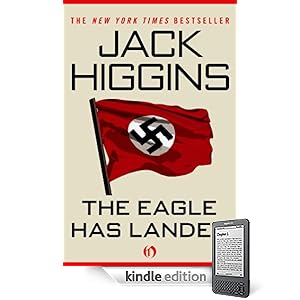
For years, in my head, I had trouble keeping Higgins' The Eagle Has Landed seperate from Frederick Forsyth's The Day of the Jackal (both were thrillerish books written in the '70s with movie adaptaions). That was a shame, since both books have a lot to offer of themselves (and aren't really similiar in any way). I was able to read Jackal several months ago (and watch the niffy movie adaption), so I finally got around to reading the Higgins book.
Eagle, set in 1943, concerns a German plot to capture Winston Churchill on British soil. Set in motion with comments from Hitler (following the rescue of Benito Mussolini by a team of German special forces), it starts out as just a planning exercise (with the hope that Hitler will forget it) but takes on a will of its own as the planner (Colonel Max Radl) begins to believe that the plan could work. Radl finds that Churchill is planning to visit the samll isolated town of Studley Constable, and there is already a German agent in place (Joanna Grey , a South Africian who moved to England after the Boer War). Radl finds the perfect head of the mission in Lt. Col. Kurt Steiner (who has an American mother and was educated in England), and decides that IRA operative Liam Devlin would be the right person to lay the groundwork.
****SPOILERS***
The paratroopers infiltrate the villiage (posing as a Polish squad on manevers) and for a time the plan seems as if it might succeed. While watching the manevers, there's an accident involving children and a waterwheel, and the German's cover is blown. What follows is a siege of the villiage, as American Rangers (led by a colonel desparate for action) make a foolish frontal attack. As the Germans try to hold out, Devlin must deal with the English lass Molly that he has fallen in love with.
The book is told primarily from the German viewpoint, and at times you find yourself almost rooting for the paratroopers to pull off the mission. I'm sure this raised some eyebrows in 1975, but for me the characters of Joanna Grey and Liam Devlin are harder to like though both have reasons to hate the British (only Grey "likes" the Germans...Devlin is much more in the vein of "...the enemy of my enemy..."). The character of Steiner and Radl are well drawn, I think, as are some of the Studley Constable villiagers.
If you enjoy thrillers, especially set during WWII, then I think this is a fine example, and well worth picking up.
For years, in my head, I had trouble keeping Higgins' The Eagle Has Landed seperate from Frederick Forsyth's The Day of the Jackal (both were thrillerish books written in the '70s with movie adaptaions). That was a shame, since both books have a lot to offer of themselves (and aren't really similiar in any way). I was able to read Jackal several months ago (and watch the niffy movie adaption), so I finally got around to reading the Higgins book.
Eagle, set in 1943, concerns a German plot to capture Winston Churchill on British soil. Set in motion with comments from Hitler (following the rescue of Benito Mussolini by a team of German special forces), it starts out as just a planning exercise (with the hope that Hitler will forget it) but takes on a will of its own as the planner (Colonel Max Radl) begins to believe that the plan could work. Radl finds that Churchill is planning to visit the samll isolated town of Studley Constable, and there is already a German agent in place (Joanna Grey , a South Africian who moved to England after the Boer War). Radl finds the perfect head of the mission in Lt. Col. Kurt Steiner (who has an American mother and was educated in England), and decides that IRA operative Liam Devlin would be the right person to lay the groundwork.
****SPOILERS***
The paratroopers infiltrate the villiage (posing as a Polish squad on manevers) and for a time the plan seems as if it might succeed. While watching the manevers, there's an accident involving children and a waterwheel, and the German's cover is blown. What follows is a siege of the villiage, as American Rangers (led by a colonel desparate for action) make a foolish frontal attack. As the Germans try to hold out, Devlin must deal with the English lass Molly that he has fallen in love with.
The book is told primarily from the German viewpoint, and at times you find yourself almost rooting for the paratroopers to pull off the mission. I'm sure this raised some eyebrows in 1975, but for me the characters of Joanna Grey and Liam Devlin are harder to like though both have reasons to hate the British (only Grey "likes" the Germans...Devlin is much more in the vein of "...the enemy of my enemy..."). The character of Steiner and Radl are well drawn, I think, as are some of the Studley Constable villiagers.
If you enjoy thrillers, especially set during WWII, then I think this is a fine example, and well worth picking up.
Friday, May 13, 2011
Wednesday, May 11, 2011
Recently read: "If The Dead Rise Not" by Philip Kerr
If The Dead Rise Not

This review contains spoilers!
Another book by Kerr staring police/hotel detective/private eye Bernie Gunther. The book opens in 1934, and Gunther has left the police force and is a hotel detective at the upscale Adlon. As the Nazis continue to tighten their grip, he has to worry about his 1/4 Jewish heritage, and also about the cop he killed accidentally when he was accosted after not reacting to a spectator speaking "treason" (calling Hitler "crazy"). Berlin is trying to get ready for the 1936 Olympics;there's a mysterious death of a merchant at the Adlon and the theft of a Chinese box from the room of an American businessman Max Reles (a German American who is clearly mob connected). He then helps an American writer, Noreen Charalambides, in the investigation of the death of a former boxer, who drowned. Noreen wants find evidence of discrimination against Jews, and put pressure on the Olympics to pull out of Berlin.
He and Noreen quickly fall in love, but his investigation ruffles the feathers of the wrong people, and he is imprisoned for a time. Noreen buys his release by agreeing to drop her investigation and leaving Germany. After being released, he figures out that the merchant's death was not by natural causes, but was murder (an ice pick through the ear). He and Reles comes to an agreement: Gunther won't tell the Gestapo that Reles is Jewish, and Reles won't have his brother kill Noreen.
We then flash forward to Havana in 1954 (where Gunther ends up after his adventures in Argentina A Quiet Flame). Gunther is under an assumed name, and runs into Noreen Charalambides. She asks for his help with her daughter who is dating an older man; the man turns out to be Max Reles, who, along with his mob buddies, are running casinos in Cuba. Reles wants Gunther's help in running his hotel/casino, but turns up dead.
A lot happens in this book, and as with all the other Gunther books, it's fairly depressing. Any hint of Gunter finding happiness is typically crushed before the book is over. I did find the section in Berlin interesting, with the run up to the '36 Olympics. Both sections have the future looming over them (Berlin, with the war in the future and Cuba with Castro in prison and revolution to come). Though Gunter is world weary and beat down, he will always have his own sense of honor.
The next book, Field Gray, is out now.
This review contains spoilers!
Another book by Kerr staring police/hotel detective/private eye Bernie Gunther. The book opens in 1934, and Gunther has left the police force and is a hotel detective at the upscale Adlon. As the Nazis continue to tighten their grip, he has to worry about his 1/4 Jewish heritage, and also about the cop he killed accidentally when he was accosted after not reacting to a spectator speaking "treason" (calling Hitler "crazy"). Berlin is trying to get ready for the 1936 Olympics;there's a mysterious death of a merchant at the Adlon and the theft of a Chinese box from the room of an American businessman Max Reles (a German American who is clearly mob connected). He then helps an American writer, Noreen Charalambides, in the investigation of the death of a former boxer, who drowned. Noreen wants find evidence of discrimination against Jews, and put pressure on the Olympics to pull out of Berlin.
He and Noreen quickly fall in love, but his investigation ruffles the feathers of the wrong people, and he is imprisoned for a time. Noreen buys his release by agreeing to drop her investigation and leaving Germany. After being released, he figures out that the merchant's death was not by natural causes, but was murder (an ice pick through the ear). He and Reles comes to an agreement: Gunther won't tell the Gestapo that Reles is Jewish, and Reles won't have his brother kill Noreen.
We then flash forward to Havana in 1954 (where Gunther ends up after his adventures in Argentina A Quiet Flame). Gunther is under an assumed name, and runs into Noreen Charalambides. She asks for his help with her daughter who is dating an older man; the man turns out to be Max Reles, who, along with his mob buddies, are running casinos in Cuba. Reles wants Gunther's help in running his hotel/casino, but turns up dead.
A lot happens in this book, and as with all the other Gunther books, it's fairly depressing. Any hint of Gunter finding happiness is typically crushed before the book is over. I did find the section in Berlin interesting, with the run up to the '36 Olympics. Both sections have the future looming over them (Berlin, with the war in the future and Cuba with Castro in prison and revolution to come). Though Gunter is world weary and beat down, he will always have his own sense of honor.
The next book, Field Gray, is out now.
Subscribe to:
Comments (Atom)